Note: This is an older study. For up-to-date data, check out our newer studies on how much Uber drivers make, and how much Uber Eats drivers make
Finding out how much money Uber drivers actually make in the real world isn’t very easy. The information Uber publishes about driver income is rosy at best and misleading at worst, and most of what’s available online comes from drivers who use optimistic numbers to try to sign up new drivers. On driver forums and Facebook groups, drivers either complain about their worst day or brag about their highest payday ever.
My goal is to compile enough data to show how much real Uber drivers in the US make right now on average. I created an easy earnings survey that asked drivers to show how much they made recently, how much Uber takes out, and how much pay drivers are left with in the end.
After hearing back from many drivers, I’ve come up with Uber driver earnings data that gives a fairly wide-reaching look into how much drivers actually make.
How much money does an Uber driver make in the US?
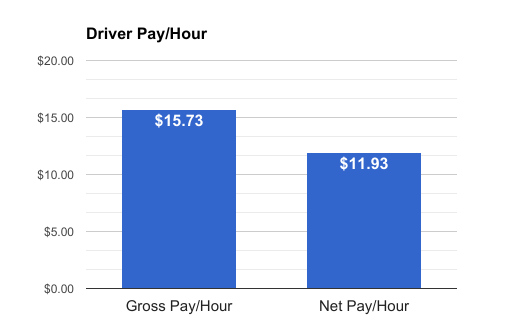
The Uber drivers I surveyed make $15.73 per hour before expenses and $11.93 per hour after subtracting vehicle expenses.
Continue reading to see what kind of data I gathered and how I calculated those income figures.
Drivers gave me tons of great, detailed data – Thank you!
The top question people have is, “How much do Uber drivers make per hour/mile/trip?” I believe I was able to answer that question with the information I gathered from this survey. I collected raw income data, data about Uber’s fee, data about miles driven, hours worked, and trips completed. From that raw data, I was able to come up with accurate earnings calculations.
I calculated how much drivers make, then subtracted how much drivers spend and how much Uber takes out in fees, then divided that sum by hours, miles, and trips. The resulting figures gave me driver earnings by the hour, mile, and trip.
I’m very grateful to report that drivers put in over 50 entries into my survey — enough to help me come to some pretty interesting conclusions that make a broad statement about how much drivers make today. Drivers are out there putting in tons of hours, tons of miles, and tons of trips, and I couldn’t have created any of this info without their help. You can view the survey responses here.
How much Uber drivers make before subtracting vehicle expenses
How much do Uber drivers make on average? I began to investigate that question by calculating gross earnings from the data I collected. I made the decision not to collect vehicle expense information in the survey because I thought it would add a level of complication that would make the data difficult to work with. My plan was to use a generalized expense number to help me come up with a net earnings figures that I think represents the average driver.
The average Uber driver makes $15.73 per hour and $0.83 per mile before accounting for vehicle expenses.
| Gross Uber Driver Pay Per Hour | $15.73 |
| Gross Uber Driver Pay Per Mile | $0.83 |
| Gross Uber Driver Pay Per Trip | $8.90 |
My take: The gross earnings data I collected falls somewhat in line with the optimistic earnings data put out by Uber, and the numbers reported drivers who don’t account for their expenses. It’s easy to think of your earnings in terms of the gross amount because that’s how the Uber driver app reports them! You go out to drive, open up the app, and see how much Uber is sending you for your day of work. It’s easy not to account for your expenses because you may not have done that for a job before.
How much Uber drivers make after subtracting vehicle expenses
The Uber drivers I surveyed make $11.93 per hour and $0.63 per mile after accounting for vehicle expenses. To arrive at that number, I had to calculate total vehicle expenses for all the drivers I surveyed.
Vehicle expenses are the most significant expense for Uber drivers. There’s gas, wear and tear on your car, depreciation, cleaning and upkeep expenses, and unexpected odds and ends that drivers pay for along the way. My next step to calculate real Uber driver earnings was to factor in vehicle expenses.
Accurately surveying drivers about vehicle expenses is a challenge, so I used some data from The Rideshare Guy to help me generalize costs. Harry accounted for gas, maintenance, and depreciation and came up with average vehicle running costs of $0.20/mile. I think his vehicle and his experience are representative of the average vehicle that drivers use, so I used his number.
Vehicle expenses may be higher or lower than his figure, but it gave me a broad starting point to help figure out what a large population of drivers might be paying out of pocket.
By multiplying the total number of miles driven by $0.20, I was able to come up with a total vehicle expenses figure for all the drivers I surveyed.
| Net Uber Driver Pay Per Hour | $11.93 |
| Net Uber Driver Pay Per Mile | $0.63 |
| Net Uber Driver Pay Per Trip | $6.75 |
See my methodology in the survey results
- How I calculated vehicle expenses: # of miles driven * $0.2
- How I calculated net pay per hour: (Gross earnings – vehicle expenses) / total hours
- How I calculated net pay per hour: (Gross earnings – vehicle expenses) / total miles driven
- How I calculated net pay per trip: (Gross earnings – vehicle expenses) / total completed trips
Note: I didn’t include car payments or insurance in these vehicle expenses. There’s so much variation from driver to driver that I couldn’t figure out a smart way to include car payments and insurance payments into this study. Some drivers use cars they already own and don’t buy any extra insurance, while others buy cars specifically to do Uber and add on rideshare insurance policies. For a big, broad study, I couldn’t figure out a good way to account for all of those variables.
I didn’t factor in taxes!
I have not included taxes in my study – yet. I’m still researching the best way to tackle the tax issue, and once I figure out the best method I’ll update this post. I use an accountant to do my own taxes, and I’ll admit that I don’t always fully understand exactly how things play out.
I’m open to input, so if you have any suggestions on how I should tackle the tax issue, please leave a comment.
Earnings breakdown: Where Uber driver income comes from
How much of an Uber driver’s income comes from regular fares, and how much comes from other features like surge pricing and incentives? We all know how many incentives Uber throws at drivers to convince us to get on the road and stay there. But how much of an impact do those incentive programs have on driver income?
The data I collected showed the proportion of total income that each type of income accounted for.

| Fares | 86.28% |
| Surge | 8.26% |
| Boost | 1.98% |
| Bonus/Incentive | 2.52% |
| Other | 0.95% |
My take: Despite all the hype from Uber about surge pricing and other incentives, in the end most drivers make the majority of their money from regular fares. At 8.3%, it’s almost like surge pricing is the tip that most drivers hope to get from passengers.
Other bonuses and incentives like boost pay don’t seem to be making a significant dent in driver income quite yet, but it’s possible that I haven’t gathered enough data from the cities that run those promotions.
There are a few ways to look at these proportions. One one hand, you might think it’s a good thing that gimmicks don’t make up the bulk of driver income. Fares alone should be enough to make this job worth it.
On the other, most drivers think that pay has dropped so low that surge, boost, and other incentives are absolutely necessary to make this job profitable. For many drivers, a day without surge or boost isn’t a good day. From that perspective, surge and boost are far too low as a percentage of total income. It’s also disappointing to see that for all the baiting that Uber does to get drivers on the road, in the end boost and surge doesn’t put a huge dent in driver pay. These incentives clearly are designed to get drivers on the road, not reward them with massive earnings.
Total data collected in my Uber driver earnings survey
Head to the survey results to see all of the data I collected. Seeing all those numbers makes you realize how massive industry this is and how much of an impact it has on drivers. It might seem obvious to say, but every number I listed above was 0 only a few years ago, and now today thousands of rides are being given, and incredible amounts of of money are flowing – both into driver pockets and into Uber’s pocket.
Some notes on my methods – I did my best, but I’m not a statistician
I’ve done my best to do a complete and accurate look at driver income, but I’m not a statistician or a finance expert. I used simple math and simple sampling techniques to reach my conclusions. The survey results and my calculations are publicly available for all to see, so if you see any flaws in my techniques, please let me know! You’re also free to download the data yourself and work it however you’d like.
Drivers reported their income, uber’s fee, and their total pay. I had to eliminate a few entries where the math just didn’t add up. I think that most discrepancies were because of the way I designed the survey. I didn’t included every possible expense or income category, so drivers may have left off a figure that wasn’t possible to enter, leading to a discrepancy between income, uber’s fee, and final pay. Drivers reported their income after Uber’s fee, and I tabulated the same number based on what driver input. The number I calculated was 98% the same as the numbers they gave, so I consider much of the data that they input to be accurate.
Your own earnings may be different from the figures I calculated
Whenever a driver shares how much they make, or whenever someone attempts to create a broad look at driver earnings like the one I’ve done here, drivers chime in to say how different their own results are from the reported figures. If your own experience of Uber is way different from what I’ve reported here, please enter how much you make into my survey so my calculations reflect your experiences. Add to the data, and add to the conversation.
Future info I hope to add to this page
I’m satisfied with the conclusions I’ve come to so far, but this project is far from over. I’m going to work to get more and more drivers to share their earnings so I can get an even clearer picture of driver earnings as time goes on.
The next questions I want to tackle with data from this survey are:
- How does Uber driver income breaks down city to city?
- How much do drivers pay in taxes?
- How is driver pay changing over time?
This project isn’t done – I still need your help!
By sharing your earnings info, you’re helping yourself, other drivers, and drivers who are thinking about trying Uber. With constant rate cuts and more and more complicated incentives, clear income information is more important than ever.
Take my Uber driver earnings survey (No longer available while I redesign the survey)
Even though I’ve come up with preliminary data about Uber driver income, I want to keep collecting data from drivers so I can update my findings. The more data I get, the more accurate my numbers will be!
The survey should only take a few minutes to complete. I don’t ask for any personal information or your email address. All survey responses will be visible online.
You’re doing a big service to the ride share community by participating in this survey. You’ll help other drivers know how their earnings compare, and you’ll help potential drivers find out if it’s actually worth it to drive for Uber in their city.
Sure says
I scanned quickly through this and it appears you’re apologetic. Jeez, don’t worry, were all capable of doing basic math. If numbers didn’t work in some way, wet wouldn’t be doing it.
Goli says
Wrong information. Uber eats driver gets only 64.89% Uber takes away 35%, which i a lot, i mean reallya lot. No worth to drive for uber eats.
GIVEN MABUNDA says
Being an uber driver is well and great only if you got your own slot,but driving for a partner its a slaving as an uber driver,you work hard for somebody’s survival,while they don’t care if you as a driver has something to live with or not,if uber can cancel fleet/partners company and give drivers slot to work for themselfs then we will say uber is great and taking care for the drivers
Ike says
This is biased, the IRS says you can deduct .58 a mile, Uber driver makes …83 a mile. That’s 25 cents a mile. Basically peanuts, illegally low, and completely not worth it.
Uber4life says
First several factors should be taken under consideration before answering a two fold question.
Question 1: How much is an Uber Driver charging for providing professional transportation services?
Question 2: How much should an Uber Driver be charging for providing professions transportation services?
Factor 1: A taxi cab service charges anywhere from $2-$3.50 for starting the meter and $2-$4 per mile and $15-$30 per hour waiting time.
• A taxi cab maybe a 4 door sedan, 4 door SUV, A Mini Van or High Capacity Passenger.
• Taxi Driver must have a issues Taxi License from the appropriate agency.
• Taxi Vehicle must have commercial insurance coverage.
• Can only pickup in the city that it is licensed in but can drop off in any city the passenger wishes to go to.
• Drivers and Vehicles are regulated by local agency assigned to the task
• Taxi cab rates must be displayed on the outside of vehicle on the front passenger and driver doors. Must be displayed on the interior dashboard easily visible from the back passenger seats.
• The rates are given by the city as a guideline to the min and max rates that can be charged. This allows for a small variance allowing fare completion.
Factor 2: Uber is a Peer to Peer service provider such as Craigslist and Offerup.
•. Peer to Peer services helps two different parties get together, make a deal and shake hands on the agreed terms. Usually one Peer is the buyer looking for goods and services to purchase. And the other Peer is the provider of such goods or services.
.
•. Peer (buyer) I looking for transportation services.
• Uber reply to Peer (buyer) I have a list of individual drivers providing such service.
• Uber message to Peer (seller) , I have a Peer (buyer) looking to pay for your transportation services.
• Peer (sellers). Ok I available to discuss my services and rates.
• Uber reply to Peer (sellers) ok I will connect the two of you to discuss the terms.
That’s not what is happening. The Peer (buyer) notifies Uber that they are looking for transportation services. Uber asks from where to wheee? peer (Buyer) (point A to point B). Uber ok here are your options and prices. Peer (Buyer). I want this service. Uber contacts Peer (seller). I have a Peer Buyer for your services and I already negotiated the terms of the deal but I can’t te you the final price, do you want the deal?
This is like You posting a sofa on Craigslist to sell and Craigslist tells the person selling the sofa that the final saw price was negotiated and buyer is ready to buy but I can’t tell you how much I sold your sofa for, want to sell it? Basically Uber just sold you $1000 sofa for $50 and charging you for it.
Factor 3: Uber does not give The Peer (Buyer) the option how the funds are handled Driver is paying for banking services without an option to provide it themselves.
Factor 4: Peer (seller) has no say with the final sale price.
Factor 5, Peer (seller) has no say with the insurance options.
Factor 6 Peer(seller) and Peer(buyer) have no say how their personal wireless data connection is used by Uber’s business needs.
Factor 7. Peer (seller) has no option not to participate in lower rate promotions.
Factor 8: Peer (seller) has no option whether to activate additional services provided by Uber for a small nominal fee per transaction.
Factor 9: Uber is controlling Peer (seller) treating them like an employee.
Factor 10: Uber is treating Peer (seller) like an independent contractor using their resources to and making them pay themselves with their own money.
Factor 11. When Uber drops the rates from 1:45 to .60 why is Uber using that as a tax right off Bnd not the Peer (Drivers)?
So what is the real answer? Answer is that a driver is not an Uber Driver, they are individuals using a peer to peer service provided by Uber.
The Riders are not Uber Riders, they do not directly buy any goods or services from Uber.
The riders are customers of the drivers. Uber was built using Money Owed to the drivers hence the drivers should have shares in the company stocks. Either give pat back the money that is owed or give the drivers shares in the company equivalent to what is owed. There would be no strikes if the drivers knew they were getting a piece of a company they worked hard and made sacrifices to build.
Uber has crippled the transportation industry and the public will have very little options when Uber begins to employee its drivers only and hikes the prices back up. The independent drivers have no choice but to be an hourly employee (participating in a Shared tip pool policy) or find something to do other than what they hVe been doing for som many years.
Using the calculations provided an Uber Driver who rents a vehicle makes $11 per hour + tips before taxes. An 8 hour shift = $88 before taxes.
Uber (using current business model) makes $13.25 per hour.
Uber (using future business model) $45-$60 per hour per driver after taxes.
Kira Skog says
I calculated some tax information. I am unsure if Uber pays it’s drivers Social security and Medicare taxes or does any tax withholding at all. So I ran the numbers as if the uber driver is completely self-employed. If the Uber driver makes approximately $12 an hour and works 10 hours a day for 7 days a week in a 31 day month, they will make about $3720. That is $840 a week. Multiply $840 by 52 and you get approximately $43,680 a year. Now for simplicity sake, I rounded that up to $45,000 a year, that gives us a buffer of an extra $1320 for tips and such. The federal income tax right now is about 12%, the average state income tax is about 6%. As a person who is self-employed like in this scenario, you have to pay all of the Social Security tax and Medicare tax. If you were employed by an employer those taxes are usually split 50/50. Right now the percentage of Social Security tax that the government expects is 12.4% and the Medicare tax is about 3%. Added up that is close to 34% of your paycheck that you have to give to the government every year. So if you wait till the end of the year that is about $15,300 you have to come up with in order to pay your taxes. The easier way is to withhold. Take 34% of your paycheck a month and withhold it for taxes. If a person makes $45,000 they would make $3,750 a month 34% of $3,750 is $1,275. So each month they would take out that money for taxes. After taxes, a person would make about $29,700 a year or about $2,475 a month.
DougH says
The other thing to keep in mind is that drivers get a big tax deduction from mileage. At 58 cents/mile a full-time driver can get a deduction in the $20,000s
JoshK says
There is a reason for that deduction. It costs money to operate a vehicle. That IRS mileage rate is based on the average operating expense of a vehicle to include gas, maintenance, depreciation, etc. AAA did a study in 2017 on cost per mile to drive several different types of vehicles, and even a small sedan costs $0.42 per mile, while a full-size pickup will cost you over $0.80 per mile. Harry the rideshare guy’s estimated operating expenses of $0.20 per mile is way too low.
Ben says
Also worth noting that the IRS provides a deduction of 50% of Social Security & Medicare taxes for self-employed, so there is no additional tax burden for being self employed.
So if $12/hour equates to 63 cents/mile and the IRS allows a 58 cent/mile expense, an Uber driver should only be paying taxes on 5 cents/mile or less than 10% of their earnings after expenses.
When you factor in the mileage deduction getting to/from the areas you drive I would expect that a driver who is a contractor is going to pay essentially 0% in taxes.
Eric Hersberger says
Once you factor in taxes that pay is going to go down a lot. Because they are hired as independent contractors that means they are essentially self employed. That means they will get 1099-ed at the end of the year and be responsible for the employers and employees portion of payroll taxes. Excluding federal, state, and local taxes there goes another 14% of your gross to social security tax and Medicare tax. Add back in the federal, state, and local taxes and your bringing home a lot closer to minimum wage.
DougH says
Agreed! I wrote here about other tax issues for Uber/Lyft drivers