Note: This is an older study. For up-to-date data, check out our newer studies on how much Uber drivers make, and how much Uber Eats drivers make
Finding out how much money Uber drivers actually make in the real world isn’t very easy. The information Uber publishes about driver income is rosy at best and misleading at worst, and most of what’s available online comes from drivers who use optimistic numbers to try to sign up new drivers. On driver forums and Facebook groups, drivers either complain about their worst day or brag about their highest payday ever.
My goal is to compile enough data to show how much real Uber drivers in the US make right now on average. I created an easy earnings survey that asked drivers to show how much they made recently, how much Uber takes out, and how much pay drivers are left with in the end.
After hearing back from many drivers, I’ve come up with Uber driver earnings data that gives a fairly wide-reaching look into how much drivers actually make.
How much money does an Uber driver make in the US?
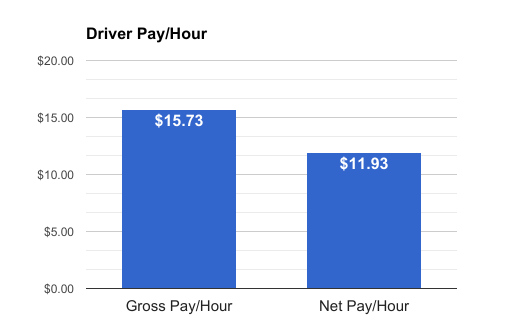
The Uber drivers I surveyed make $15.73 per hour before expenses and $11.93 per hour after subtracting vehicle expenses.
Continue reading to see what kind of data I gathered and how I calculated those income figures.
Drivers gave me tons of great, detailed data – Thank you!
The top question people have is, “How much do Uber drivers make per hour/mile/trip?” I believe I was able to answer that question with the information I gathered from this survey. I collected raw income data, data about Uber’s fee, data about miles driven, hours worked, and trips completed. From that raw data, I was able to come up with accurate earnings calculations.
I calculated how much drivers make, then subtracted how much drivers spend and how much Uber takes out in fees, then divided that sum by hours, miles, and trips. The resulting figures gave me driver earnings by the hour, mile, and trip.
I’m very grateful to report that drivers put in over 50 entries into my survey — enough to help me come to some pretty interesting conclusions that make a broad statement about how much drivers make today. Drivers are out there putting in tons of hours, tons of miles, and tons of trips, and I couldn’t have created any of this info without their help. You can view the survey responses here.
How much Uber drivers make before subtracting vehicle expenses
How much do Uber drivers make on average? I began to investigate that question by calculating gross earnings from the data I collected. I made the decision not to collect vehicle expense information in the survey because I thought it would add a level of complication that would make the data difficult to work with. My plan was to use a generalized expense number to help me come up with a net earnings figures that I think represents the average driver.
The average Uber driver makes $15.73 per hour and $0.83 per mile before accounting for vehicle expenses.
| Gross Uber Driver Pay Per Hour | $15.73 |
| Gross Uber Driver Pay Per Mile | $0.83 |
| Gross Uber Driver Pay Per Trip | $8.90 |
My take: The gross earnings data I collected falls somewhat in line with the optimistic earnings data put out by Uber, and the numbers reported drivers who don’t account for their expenses. It’s easy to think of your earnings in terms of the gross amount because that’s how the Uber driver app reports them! You go out to drive, open up the app, and see how much Uber is sending you for your day of work. It’s easy not to account for your expenses because you may not have done that for a job before.
How much Uber drivers make after subtracting vehicle expenses
The Uber drivers I surveyed make $11.93 per hour and $0.63 per mile after accounting for vehicle expenses. To arrive at that number, I had to calculate total vehicle expenses for all the drivers I surveyed.
Vehicle expenses are the most significant expense for Uber drivers. There’s gas, wear and tear on your car, depreciation, cleaning and upkeep expenses, and unexpected odds and ends that drivers pay for along the way. My next step to calculate real Uber driver earnings was to factor in vehicle expenses.
Accurately surveying drivers about vehicle expenses is a challenge, so I used some data from The Rideshare Guy to help me generalize costs. Harry accounted for gas, maintenance, and depreciation and came up with average vehicle running costs of $0.20/mile. I think his vehicle and his experience are representative of the average vehicle that drivers use, so I used his number.
Vehicle expenses may be higher or lower than his figure, but it gave me a broad starting point to help figure out what a large population of drivers might be paying out of pocket.
By multiplying the total number of miles driven by $0.20, I was able to come up with a total vehicle expenses figure for all the drivers I surveyed.
| Net Uber Driver Pay Per Hour | $11.93 |
| Net Uber Driver Pay Per Mile | $0.63 |
| Net Uber Driver Pay Per Trip | $6.75 |
See my methodology in the survey results
- How I calculated vehicle expenses: # of miles driven * $0.2
- How I calculated net pay per hour: (Gross earnings – vehicle expenses) / total hours
- How I calculated net pay per hour: (Gross earnings – vehicle expenses) / total miles driven
- How I calculated net pay per trip: (Gross earnings – vehicle expenses) / total completed trips
Note: I didn’t include car payments or insurance in these vehicle expenses. There’s so much variation from driver to driver that I couldn’t figure out a smart way to include car payments and insurance payments into this study. Some drivers use cars they already own and don’t buy any extra insurance, while others buy cars specifically to do Uber and add on rideshare insurance policies. For a big, broad study, I couldn’t figure out a good way to account for all of those variables.
I didn’t factor in taxes!
I have not included taxes in my study – yet. I’m still researching the best way to tackle the tax issue, and once I figure out the best method I’ll update this post. I use an accountant to do my own taxes, and I’ll admit that I don’t always fully understand exactly how things play out.
I’m open to input, so if you have any suggestions on how I should tackle the tax issue, please leave a comment.
Earnings breakdown: Where Uber driver income comes from
How much of an Uber driver’s income comes from regular fares, and how much comes from other features like surge pricing and incentives? We all know how many incentives Uber throws at drivers to convince us to get on the road and stay there. But how much of an impact do those incentive programs have on driver income?
The data I collected showed the proportion of total income that each type of income accounted for.

| Fares | 86.28% |
| Surge | 8.26% |
| Boost | 1.98% |
| Bonus/Incentive | 2.52% |
| Other | 0.95% |
My take: Despite all the hype from Uber about surge pricing and other incentives, in the end most drivers make the majority of their money from regular fares. At 8.3%, it’s almost like surge pricing is the tip that most drivers hope to get from passengers.
Other bonuses and incentives like boost pay don’t seem to be making a significant dent in driver income quite yet, but it’s possible that I haven’t gathered enough data from the cities that run those promotions.
There are a few ways to look at these proportions. One one hand, you might think it’s a good thing that gimmicks don’t make up the bulk of driver income. Fares alone should be enough to make this job worth it.
On the other, most drivers think that pay has dropped so low that surge, boost, and other incentives are absolutely necessary to make this job profitable. For many drivers, a day without surge or boost isn’t a good day. From that perspective, surge and boost are far too low as a percentage of total income. It’s also disappointing to see that for all the baiting that Uber does to get drivers on the road, in the end boost and surge doesn’t put a huge dent in driver pay. These incentives clearly are designed to get drivers on the road, not reward them with massive earnings.
Total data collected in my Uber driver earnings survey
Head to the survey results to see all of the data I collected. Seeing all those numbers makes you realize how massive industry this is and how much of an impact it has on drivers. It might seem obvious to say, but every number I listed above was 0 only a few years ago, and now today thousands of rides are being given, and incredible amounts of of money are flowing – both into driver pockets and into Uber’s pocket.
Some notes on my methods – I did my best, but I’m not a statistician
I’ve done my best to do a complete and accurate look at driver income, but I’m not a statistician or a finance expert. I used simple math and simple sampling techniques to reach my conclusions. The survey results and my calculations are publicly available for all to see, so if you see any flaws in my techniques, please let me know! You’re also free to download the data yourself and work it however you’d like.
Drivers reported their income, uber’s fee, and their total pay. I had to eliminate a few entries where the math just didn’t add up. I think that most discrepancies were because of the way I designed the survey. I didn’t included every possible expense or income category, so drivers may have left off a figure that wasn’t possible to enter, leading to a discrepancy between income, uber’s fee, and final pay. Drivers reported their income after Uber’s fee, and I tabulated the same number based on what driver input. The number I calculated was 98% the same as the numbers they gave, so I consider much of the data that they input to be accurate.
Your own earnings may be different from the figures I calculated
Whenever a driver shares how much they make, or whenever someone attempts to create a broad look at driver earnings like the one I’ve done here, drivers chime in to say how different their own results are from the reported figures. If your own experience of Uber is way different from what I’ve reported here, please enter how much you make into my survey so my calculations reflect your experiences. Add to the data, and add to the conversation.
Future info I hope to add to this page
I’m satisfied with the conclusions I’ve come to so far, but this project is far from over. I’m going to work to get more and more drivers to share their earnings so I can get an even clearer picture of driver earnings as time goes on.
The next questions I want to tackle with data from this survey are:
- How does Uber driver income breaks down city to city?
- How much do drivers pay in taxes?
- How is driver pay changing over time?
This project isn’t done – I still need your help!
By sharing your earnings info, you’re helping yourself, other drivers, and drivers who are thinking about trying Uber. With constant rate cuts and more and more complicated incentives, clear income information is more important than ever.
Take my Uber driver earnings survey (No longer available while I redesign the survey)
Even though I’ve come up with preliminary data about Uber driver income, I want to keep collecting data from drivers so I can update my findings. The more data I get, the more accurate my numbers will be!
The survey should only take a few minutes to complete. I don’t ask for any personal information or your email address. All survey responses will be visible online.
You’re doing a big service to the ride share community by participating in this survey. You’ll help other drivers know how their earnings compare, and you’ll help potential drivers find out if it’s actually worth it to drive for Uber in their city.
Josh says
You’ve got an ad on your page by Uber which says “make $20-$40 an hour”
This seems to contradict what you’re article is saying. Are Uber making it up?
Royale says
Nice article with well done data analysis. Thanks for posting this.
Just wanted to bring up that you have a response from Lahore (Pakistan) with currency’s worth like 1/100 of USD. You may want to convert this to USD and also look for other users with non-USD currencies.
DougH says
Thanks for the heads up!
Will says
Although I am still waiting to pick up my rental this wednesday that I’ve obtained through Lyft and Hertz, I’ve been delivering food via UberEATS for 2-3 months now. I don’t have the exact numbers on hand, but when I started I was easily coming out with a net pay of around $300/week. This was working only during the 1.3x boost from 11am – 2pm and the 1.4x boost from 5pm – 9pm on Monday – Thursday, then the same on Friday except the second boost ran until 10pm instead of 9pm, and weekends were 1.3x from 11am – 5pm and then 1.4x from 5pm – 10pm on Saturday and 5pm – 9pm on Sunday.
The downside came 3 weeks ago when then cut off these available boost zones from all over the greater metro area (I live in Phoenix, AZ) down to only the college town area of the suburb where Arizona State University is located. And then, starting this past week, they’ve reduced the time blocks down to 11am – 2pm and then 5pm – 8pm every day of the week. Because of this I’ve gone from making a minimum of $15/hr (before expenses, but I deliver on my motorcycle so those are relatively low anyway) down to $9/hr on a good day. Unfortunately, this is less than our state’s minimum wage of $10/hr and is the reason I have elected to rent a car using the Lyft Express Drive Program.
I will be happy to fill out your survey once I’ve gotten a week or so under my belt using the Lyft platform.
Also, I feel it may be good to mention that, at least here in Arizona, the taxable percentage at the end of the year for someone who is self-employed is always 15.9% of gross income (I may be a point or two high as I haven’t checked in quite a while, but I am 100% positive it is in the higher range of the 15th percentile). This includes both federal and state taxes, and does not vary due to total gross income amount or any other factor to my knowledge. I am also unsure of whether or not this is the same in all states or just here in Arizona, but I thought it may be a good starting point for any future research you do on the matter. I’m sure a quick google search for “different states’ self-employed tax amount” or something similar would reveal the difference in percentiles throughout different states.
DougH says
Thanks for the info!
JAmes says
Your statement can’t be further from the truth. What you are speaking of is SE Tax (Self employment tax). It accounts for social security and Medicare. With a regular job you pay 7.65% and your employer matches it with 7.65% totaling 15.3%. That is the amount you speak of. That is not your TOTAL tax. After that you will have to pay Federal withholding, which the % changes based on your income level and your state income tax (if any).
Mary says
Your article certainly put everything in perspective for me! To a fault, I need (and love) details; the more I know, the better (I believe) I can be at making an informed decision.
As a Senior citizen apparently considered no longer employable (just because I had the audacity to keep living and enjoying good health – imagine that!!), UBER and LYFT had become strong considerations for “encore” career choices.
For me, the first UBER drawback occurred when I learned their requirements for renting certain vehicle types, from certain dealers. (I have a 2008 Mustang and aside from being too small to transport passengers, its considered too old). Adding up the rental costs, however, sealed the deal. For me – someone struggling to regain my financial footing and to get a savings going again – paying $700 a month for an UBER rental doesn’t make sense. Better to continue scrimping and saving (on a part time income it’s a stretch – believe me)toward a $1,000 – 1,500 down payment for a car of my own.
I didn’t go as far in my LYFT research as I did with UBER but at this point, I’m pretty sure that my absolute best option is to focus on learning to monetize the passions and skills that I have previously provided free of charge for years, and learn how to become an effective and impactful entrepreneur.
Putting together all of the information I’ve learned from your article and from the posters Tyler and Mark in the Comments section, provided me with a wealth of well-thought out, informative data, and I truly, truly, thank you. I will be following you from now on.
DougH says
I’m glad the post was helpful for you! I think you made a solid assessment. The rentals cost too much for most people, and purchasing your own affordable car is usually the best way to go. Most of the same information applies to Lyft as well. If you do end up driving, I recommend signing up for both companies right away. Both offer new-driver bonuses and both are worth experimenting with.
Steve L says
I’m about ready to retire and am trying Uber as a supplemental income source and for something worthwhile (I hope) to do. As a data analyst, I’ve crunched the numbers for driving in the Hartford, CT area (I live in Rocky Hill which is 10 miles south of Hartford).
I do both ride and delivery. I’ve had a total of 170 trips. I’ve included time to drive to a rider or pickup and drive home from last rider or pickup at the end of the day. Total invested hours is 91.8. Total gross earnings (with tips given in the Uber app as Hartford area riders and deliveries can tip in the Uber app) was $1,480.87. That equates to a gross hourly rate of $16.12. If you account for gas (at an average of $2.80/gal), the net was $1,235.91 or $13.46/hr.
Here’s the kicker, I took out a commercial auto policy at a premium of $1,950 per year as the personal auto policy will not provide any coverage once your turn the Uber app on. Although Uber provides insurance for the driver, it is limited during level 1 of the app being on (no physical damage coverage for your car and lower liability limits). Full coverage kicks in during level 2 and 3 as long as your own insurance has full coverage. So you need to commercial policy to be fully coverage at all times while the app is on. I also includes other expenses (lease, maintenance, car wash, bottle water, candy and satellite radio). Total expenses (including gas) amounts to $1,018, leaving a net profit of $462. That net profit equates to an hourly rate of $5.00/hr.
Note, only about 10% or riders and pickups will tip. You really need to be outstanding to earn a tip from an Uber customer. To get a tip, the rider or pickup must first rate the driver. If they don’t rate, they will never see the tip option in the app. Only 35% have taken the time to complete the rating (63 out of 170 trips). Most tips are between $1 and $3. I have also received cash tips ($55) which is not included in the above earnings analysis.
Bottom line, you can meet some great and very interesting people, but you won’t get rich doing it (at least in Hartford, CT). Uber rate in Hartford in $.75/ mile and $.08/minute for non surge times. Base fare is $.75. Minimum fare is $3.00.
Hope this helps everyone in their decision making process.
DougH says
Thanks for your detailed comment. I agree with your bottom line!
Yvan says
oh boy you are paid poorly in the insurance capital(my dad worked more than 30 years for the Hartford insurance group in montréal). Ok in montréal we have 1.28$ a mile .19 cents a minute and base fare 1.90$.
Cheryl says
Thanks for the article and time you put into it.
DougH says
You’re welcome! Glad you enjoyed it 🙂
Mark says
Whenever I encounter a situation that requires assessment of vehicle expenses, I use the standard mileage deduction the IRS uses. One thing we know about the IRS is that they aren’t going to give the taxpayer anything. In other words, the standard mileage deduction is probably highly accurate. The rate for 2017 is 53.5 cents per mile.
21035.98 (miles) x .535= $11254,25 vehicle expenses
$17,435.47 (gross earnings) – $11254.25 = $6181.22 net earnings
Uber drivers are self employed sole proprietors. They are subject to self employment tax, which is 15.3%. This is the employee and employer share of social security and medicare. Self employed pay both shares BEFORE any standard or personal deductions. The good news here, half of the self employment tax can be deducted from income to lower the AGI on form 1040. The bad news….students will no longer be able to use 1040 EZ because they are self employed.
6181.22(net earnings) x..153 (self employment tax)= $945.73
6181.22 – 945.73= $5235.49
$5235.49 / 1108.59 (total hours driven)= $4.72/ hour net
This is how an accountant or statistician would calculate how much an Uber driver makes and is why ALL accountants and financial advisers will tell you that Uber is NOT a good deal for drivers. When calculated correctly, their wage is less than minimum wage. They would be far better off working a shift at the local McDonald’s, and riding their bike to work, than they are driving for Uber.
DougH says
Thanks for the comment!
Tyler says
Hey man, excellent write up.
I’m doing some consumer behavior research related to Uber driving, and I’m curious about the “baiting” techniques Uber uses to get drivers out on the road. What are some of those techniques? What messages do they send to you?
A lot of what I’m interested in is related to this article (https://www.nytimes.com/interactive/2017/04/02/technology/uber-drivers-psychological-tricks.html) – is there anything sensationalized about it?
Thank you for your help!
Best,
Tyler