Note: This is an older study. For up-to-date data, check out our newer studies on how much Uber drivers make, and how much Uber Eats drivers make
Finding out how much money Uber drivers actually make in the real world isn’t very easy. The information Uber publishes about driver income is rosy at best and misleading at worst, and most of what’s available online comes from drivers who use optimistic numbers to try to sign up new drivers. On driver forums and Facebook groups, drivers either complain about their worst day or brag about their highest payday ever.
My goal is to compile enough data to show how much real Uber drivers in the US make right now on average. I created an easy earnings survey that asked drivers to show how much they made recently, how much Uber takes out, and how much pay drivers are left with in the end.
After hearing back from many drivers, I’ve come up with Uber driver earnings data that gives a fairly wide-reaching look into how much drivers actually make.
How much money does an Uber driver make in the US?
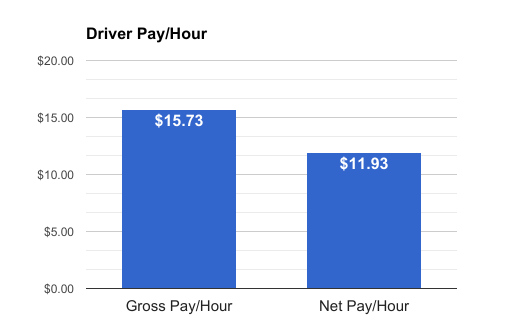
The Uber drivers I surveyed make $15.73 per hour before expenses and $11.93 per hour after subtracting vehicle expenses.
Continue reading to see what kind of data I gathered and how I calculated those income figures.
Drivers gave me tons of great, detailed data – Thank you!
The top question people have is, “How much do Uber drivers make per hour/mile/trip?” I believe I was able to answer that question with the information I gathered from this survey. I collected raw income data, data about Uber’s fee, data about miles driven, hours worked, and trips completed. From that raw data, I was able to come up with accurate earnings calculations.
I calculated how much drivers make, then subtracted how much drivers spend and how much Uber takes out in fees, then divided that sum by hours, miles, and trips. The resulting figures gave me driver earnings by the hour, mile, and trip.
I’m very grateful to report that drivers put in over 50 entries into my survey — enough to help me come to some pretty interesting conclusions that make a broad statement about how much drivers make today. Drivers are out there putting in tons of hours, tons of miles, and tons of trips, and I couldn’t have created any of this info without their help. You can view the survey responses here.
How much Uber drivers make before subtracting vehicle expenses
How much do Uber drivers make on average? I began to investigate that question by calculating gross earnings from the data I collected. I made the decision not to collect vehicle expense information in the survey because I thought it would add a level of complication that would make the data difficult to work with. My plan was to use a generalized expense number to help me come up with a net earnings figures that I think represents the average driver.
The average Uber driver makes $15.73 per hour and $0.83 per mile before accounting for vehicle expenses.
| Gross Uber Driver Pay Per Hour | $15.73 |
| Gross Uber Driver Pay Per Mile | $0.83 |
| Gross Uber Driver Pay Per Trip | $8.90 |
My take: The gross earnings data I collected falls somewhat in line with the optimistic earnings data put out by Uber, and the numbers reported drivers who don’t account for their expenses. It’s easy to think of your earnings in terms of the gross amount because that’s how the Uber driver app reports them! You go out to drive, open up the app, and see how much Uber is sending you for your day of work. It’s easy not to account for your expenses because you may not have done that for a job before.
How much Uber drivers make after subtracting vehicle expenses
The Uber drivers I surveyed make $11.93 per hour and $0.63 per mile after accounting for vehicle expenses. To arrive at that number, I had to calculate total vehicle expenses for all the drivers I surveyed.
Vehicle expenses are the most significant expense for Uber drivers. There’s gas, wear and tear on your car, depreciation, cleaning and upkeep expenses, and unexpected odds and ends that drivers pay for along the way. My next step to calculate real Uber driver earnings was to factor in vehicle expenses.
Accurately surveying drivers about vehicle expenses is a challenge, so I used some data from The Rideshare Guy to help me generalize costs. Harry accounted for gas, maintenance, and depreciation and came up with average vehicle running costs of $0.20/mile. I think his vehicle and his experience are representative of the average vehicle that drivers use, so I used his number.
Vehicle expenses may be higher or lower than his figure, but it gave me a broad starting point to help figure out what a large population of drivers might be paying out of pocket.
By multiplying the total number of miles driven by $0.20, I was able to come up with a total vehicle expenses figure for all the drivers I surveyed.
| Net Uber Driver Pay Per Hour | $11.93 |
| Net Uber Driver Pay Per Mile | $0.63 |
| Net Uber Driver Pay Per Trip | $6.75 |
See my methodology in the survey results
- How I calculated vehicle expenses: # of miles driven * $0.2
- How I calculated net pay per hour: (Gross earnings – vehicle expenses) / total hours
- How I calculated net pay per hour: (Gross earnings – vehicle expenses) / total miles driven
- How I calculated net pay per trip: (Gross earnings – vehicle expenses) / total completed trips
Note: I didn’t include car payments or insurance in these vehicle expenses. There’s so much variation from driver to driver that I couldn’t figure out a smart way to include car payments and insurance payments into this study. Some drivers use cars they already own and don’t buy any extra insurance, while others buy cars specifically to do Uber and add on rideshare insurance policies. For a big, broad study, I couldn’t figure out a good way to account for all of those variables.
I didn’t factor in taxes!
I have not included taxes in my study – yet. I’m still researching the best way to tackle the tax issue, and once I figure out the best method I’ll update this post. I use an accountant to do my own taxes, and I’ll admit that I don’t always fully understand exactly how things play out.
I’m open to input, so if you have any suggestions on how I should tackle the tax issue, please leave a comment.
Earnings breakdown: Where Uber driver income comes from
How much of an Uber driver’s income comes from regular fares, and how much comes from other features like surge pricing and incentives? We all know how many incentives Uber throws at drivers to convince us to get on the road and stay there. But how much of an impact do those incentive programs have on driver income?
The data I collected showed the proportion of total income that each type of income accounted for.

| Fares | 86.28% |
| Surge | 8.26% |
| Boost | 1.98% |
| Bonus/Incentive | 2.52% |
| Other | 0.95% |
My take: Despite all the hype from Uber about surge pricing and other incentives, in the end most drivers make the majority of their money from regular fares. At 8.3%, it’s almost like surge pricing is the tip that most drivers hope to get from passengers.
Other bonuses and incentives like boost pay don’t seem to be making a significant dent in driver income quite yet, but it’s possible that I haven’t gathered enough data from the cities that run those promotions.
There are a few ways to look at these proportions. One one hand, you might think it’s a good thing that gimmicks don’t make up the bulk of driver income. Fares alone should be enough to make this job worth it.
On the other, most drivers think that pay has dropped so low that surge, boost, and other incentives are absolutely necessary to make this job profitable. For many drivers, a day without surge or boost isn’t a good day. From that perspective, surge and boost are far too low as a percentage of total income. It’s also disappointing to see that for all the baiting that Uber does to get drivers on the road, in the end boost and surge doesn’t put a huge dent in driver pay. These incentives clearly are designed to get drivers on the road, not reward them with massive earnings.
Total data collected in my Uber driver earnings survey
Head to the survey results to see all of the data I collected. Seeing all those numbers makes you realize how massive industry this is and how much of an impact it has on drivers. It might seem obvious to say, but every number I listed above was 0 only a few years ago, and now today thousands of rides are being given, and incredible amounts of of money are flowing – both into driver pockets and into Uber’s pocket.
Some notes on my methods – I did my best, but I’m not a statistician
I’ve done my best to do a complete and accurate look at driver income, but I’m not a statistician or a finance expert. I used simple math and simple sampling techniques to reach my conclusions. The survey results and my calculations are publicly available for all to see, so if you see any flaws in my techniques, please let me know! You’re also free to download the data yourself and work it however you’d like.
Drivers reported their income, uber’s fee, and their total pay. I had to eliminate a few entries where the math just didn’t add up. I think that most discrepancies were because of the way I designed the survey. I didn’t included every possible expense or income category, so drivers may have left off a figure that wasn’t possible to enter, leading to a discrepancy between income, uber’s fee, and final pay. Drivers reported their income after Uber’s fee, and I tabulated the same number based on what driver input. The number I calculated was 98% the same as the numbers they gave, so I consider much of the data that they input to be accurate.
Your own earnings may be different from the figures I calculated
Whenever a driver shares how much they make, or whenever someone attempts to create a broad look at driver earnings like the one I’ve done here, drivers chime in to say how different their own results are from the reported figures. If your own experience of Uber is way different from what I’ve reported here, please enter how much you make into my survey so my calculations reflect your experiences. Add to the data, and add to the conversation.
Future info I hope to add to this page
I’m satisfied with the conclusions I’ve come to so far, but this project is far from over. I’m going to work to get more and more drivers to share their earnings so I can get an even clearer picture of driver earnings as time goes on.
The next questions I want to tackle with data from this survey are:
- How does Uber driver income breaks down city to city?
- How much do drivers pay in taxes?
- How is driver pay changing over time?
This project isn’t done – I still need your help!
By sharing your earnings info, you’re helping yourself, other drivers, and drivers who are thinking about trying Uber. With constant rate cuts and more and more complicated incentives, clear income information is more important than ever.
Take my Uber driver earnings survey (No longer available while I redesign the survey)
Even though I’ve come up with preliminary data about Uber driver income, I want to keep collecting data from drivers so I can update my findings. The more data I get, the more accurate my numbers will be!
The survey should only take a few minutes to complete. I don’t ask for any personal information or your email address. All survey responses will be visible online.
You’re doing a big service to the ride share community by participating in this survey. You’ll help other drivers know how their earnings compare, and you’ll help potential drivers find out if it’s actually worth it to drive for Uber in their city.
Kevin says
Uber takes 30-50%on depends on trip distance. Also for california drivers which highest gas price in all states and uber dont doing shit. Now drivers moving to lift. LIFT. If uber dont lower their fees uber will die in couple year. This is for real.
George C says
I totaly agree When I first started With Uber about three years ago (2015);in Hoboken NJ and Jersey City the basic rider fare was 7.00 uber took out 20% and Uber booking fee was 1.05
Then Uber said the basic fare is being cut to 5.00 all the same becusebin doing this the ryder
Numbers will increse then Uber cuts rider fares again now basic is 1.05 Uber Fee is up to 25%
And Uber just double there booking fee cost all of comes out of Drivers side then driver is paid
Now to top it all off The Brain storm genius that never Did Uber as A Driven adds Pool
Now just think for a min you just leased a brand new toyota Honda or like me a 2017 Kia Cadenza Limited 45k car to get a pool ride that after all I get at times 2.31 that a Sin
Belive me Uber thinks who there are Were they miss the boat is with out goid drivers you loose
Riders ..I Stopped doing Uber all together its impossable to make any money forget if you want to drive to cover your car payment ,Insurance Fuel,car washes and oil changes
I can wait to see Uber go under and belive me when a businness like Uber keeps given the stor away with reducing fares drivers just cant afford to drive
PS when I did uber at first 3 years ago uber said you can make 35.00/ A hour well that was lye then they said 25.00 a hour 2 years later then another year after that Uber says 19.00 a hour
Belive me your figuers are right on the money a Driver is luckynto net 11.00 a hour with out the days cost of fuel and tool you dont get when your going and have to take a toll road to get back home the tools on on the driver
Uber you going to go down in flames some day and it could be sooner then later
Donna Mae Taylor says
Uber or Lyft? I was thinking driving near the Ontario Airport and Rancho Cucamonga area, I need money to pay off nursing loan and hopefully travel one day. Suggestions and tips please.
Thank you so much for all tips and suggestions.
DougH says
I recommend driving for both. Usually both offer some type of bonus or guaranteed earnings for new drivers, and it’s always good to have a backup if something goes wrong with one app.
Nicole says
I tried to complete the survey using last week’s data but I don’t see Uber’s fee on my pay statement, I think I have to look at each individual trip in the app to get that information. Unless I’m reading the questions wrong it appears you are asking for the total fare before Uber’s fee twice. I also didn’t see where I should include tips, wait time, long pick-up fees, cancellation fees. I usually average $20-$25 gross per hour of online time each week (doing this part-time). Of course this includes all possible fees (except tolls, I avoid those areas).
DougH says
Hello Nicole. I really appreciate that you’re trying to participate in my survey, but as of right now it’s outdated. It doesn’t account for those items you listed. It needs a refresh. I can’t say exactly when I’ll re-launch the updated version.
Kenneth says
I have a question. Example :If the fare was $20. What would the driver get on average? Thanks
DougH says
Generally, the driver gets 25% of the fare after subtracting the booking fee. The booking fee is around $2.10. In your scenario, if the passenger paid a total of $20, $2.10 of that would be the booking fee, which is subtracted off the top. $20-$2.10 = $17.90. Then Uber takes 25% of the remaining amount, which is, $4.47. $17.90 – $4.47 = $13.43. That’s the final amount the driver receives. That’s a basic calculation. But new features have made that more complicated to calculate. See this article for more detail: https://therideshareguy.com/how-to-calculate-ubers-percentage-in-an-upfront-fare-world/
Bill Corrigan says
The federal government shows $0.65 cents per mile as the cost to run a vehicle. That’s the number that should be used for expenses. With that Iber drivers are spending their future earnings. They aren’t making a penny but instead giving away their car for some quick cash now.
Jeremy says
That’s not the actual cost to the driver, that’s what the IRS (presumably, you don’t give a source) allows for deductions.
15,000 miles x $0.65 = $9,750.
It doesn’t cost $9,750 to operate a vehicle every year, or we’d have a LOT less cars.
Even when you factor in depreciation (loss of market value due to mileage, which is why the IRS rates are high) it’s probably roughly half that for a standard passenger car/Uber driver.
Operating costs to maintain and repair old/very high mileage vehicles can be quite expensive, but you can’t drive those for Uber, so that’s not relevant here.
My comment to the author (dough) would be to look at the spreadsheet data is and consider adding some clarification to the survey.
Also start asking people to provide a state or country rather than just a city name. “Springfield” is particularly unhelpful.
Look at the # trips then at either the Fare or the Trip earnings. Some of them are obviously VERY wrong.
michael says
hi there, i see you have put a lot of times and effort to figure out the the most important answer for everybody interested in driving uber. my application is pending approval at this moment, after reading your research finding, i had expected the pay to be more. you did great job to gather all the information to come up with the hourly pay. i am statistic freak, i just love crunching numbers, i understand and appreciate the time and effort you put into this. keep up the good work, p.s. i am still awaiting question i posted for you regarding background check 🙂
DougH says
Thanks for the nice comment! I still think it’s a good job if you can keep your costs low.
len levitsky says
Yesterday I checked my gross and net income. To my surprise uber took 40 to 60 percent of what the riders pay. Some of my passengers were shocked. How do I find out how they calculate this huge amount
gil says
yeah they once took in 8 dollars and i got paid 3.64. sure it was down the block but thats a rip off. wait til they put you in a hazard off a pool pick up. uber is a scam.